Editor’s Note
A Double Security
- By Michael Laskawy
We titled our first issue of this journal The American Promise. As we explained last summer and have reiterated since, The American Promise is our touchstone, our core belief, our worldview. Finally and fully realizing the promise made in the Declaration of Independence and the principles that follow from it—representative democracy, personal freedom, fair markets, and effective government—is The States Forum’s north star.
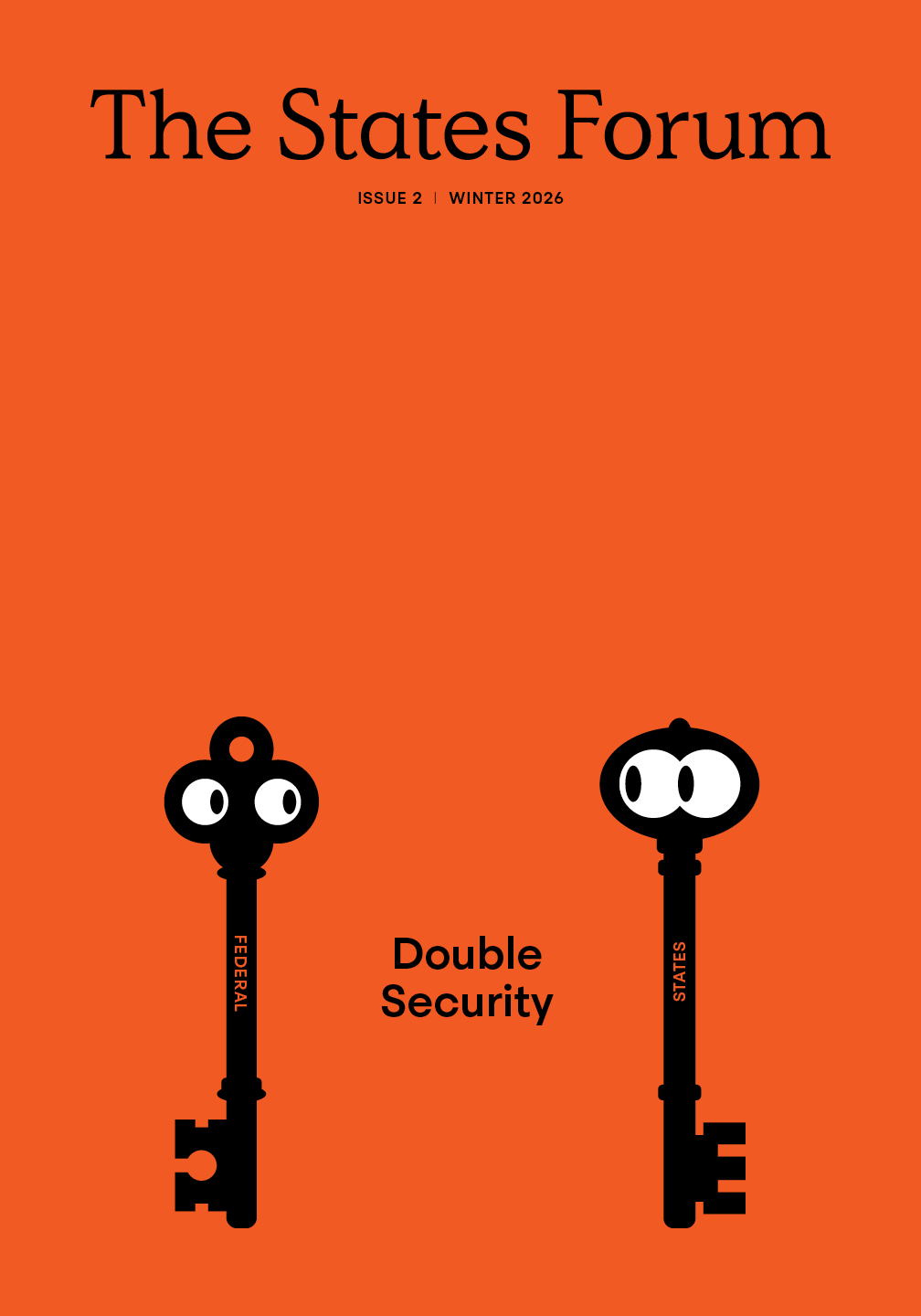
For our second issue, we’re returning to our founders for inspiration. The title of this issue, appropriate for our sophomore effort, is Double Security, a phrase that comes from James Madison’s meditation on power, Federalist No. 51. The Federalist Papers were the shared journalistic endeavor of Madison, Alexander Hamilton, and John Jay, to persuade Americans to adopt the newly drafted Constitution. Over the course of 85 essays, the three authors explained in detail how the new system would work, and how to make a fledgling democracy functional. They likewise sought to reassure their readers that the new federal government they had designed accounted for what they saw as its greatest danger: tyranny, and the impulse of officeholders, even in a democracy, to misuse and abuse power.
The need for the checks and balances we were taught about in grade school are premised on the belief that the fundamental nature of political actors is to aggrandize their own power. The system Madison and his fellow delegates to the Constitutional Convention designed was deliberately crafted to diffuse that power, making it difficult to centralize or weaponize. “Ambition,” wrote Madison, “must be made to counter ambition.”
But Madison believed that internal checks were insufficient. The resilience of the system relied, as he wrote, on a “double security”: the power of the states. This, said Madison, would provide an additional layer of protection—a way to push back against political overreach or even the dangers of a misguided democratic majority.
At this moment, we would do well to be mindful of Madison’s sophisticated and astute understanding of the dangers of political power and to celebrate his foresight. At The States Forum, we wholeheartedly agree—look to the states.
In this issue of The States Forum Journal, we aim to provide a positive vision of what that double security looks like, how democracy must not only be fought for, but sustained and improved. Rather than offering another eulogy with no solutions for a democracy in trouble, the essays in this collection treat states as the primary terrain of democratic renewal. They argue that the some of the most effective guardrails now lie in governors’ offices, statehouses, state courts, state treasuries, and local labor markets—places where policy still touches daily life and where citizens can see their government working in real time
For this edition, The States Forum Executive Director Lise Clavel speaks with Ambassador Susan Rice. Their conversation makes clear the perilous moment we face while offering a set of prescriptions for how we should respond. Arkadi Gerney, Sarah Knight, Suzanne Nossel, and Harrison Stark propose specific policy ideas for states on how to empower their citizens and protect against federal overreach. Andrew Doty, David Greenberg, Blas Nuñez-Neto, Ryan O’Toole, and Eric Scorsone explore what states can do to reassure Americans that democracy works, addressing their concerns and knitting the social and political contracts back together. And Matt Lackey, Marshall Kosloff, Adam Pritzker, and Daniel Squadron offer uplifting prescriptions for how we can move forward to make the American Promise a reality.
We hope you find these pieces intellectually stimulating, motivating, and inspiring. And we encourage you to offer your own thoughts and arguments on our website and Substack. There is work to be done in the states—where it matters more than ever.
About The Author
Michael Laskawy is the editor in chief of the The States Forum. He has served as a senior policy advisor at the federal, state, and local levels, as well as serving as the executive director of the Congressional Joint Economic Committee during the 110th Congress.