- Free Expression
Protecting Free Expression and Free Inquiry on Campuses
By Dr. Sigal Ben-Porath, MRMJJ Presidential Professor of Education at the University of Pennsylvania
The idea
A robust culture of free expression and free inquiry is a central component of democracy, and key to continued development of science, technology, and humanistic ideas for the public good. When we are free to test new ideas, challenge the status quo, and imagine a different future for ourselves and our communities, we become active participants in our shared endeavor. When people exercise their rights guaranteed under the First Amendment, our democracy as a whole becomes more resilient. When scholars are able to research and teach a broad array of views grounded in evidence and open inquiry, they can help advance the interests of society. On the other hand, government censorship and suppression of dissent stifles new ideas and erodes public trust in shared institutions, especially those driving innovation and knowledge. Protecting academic freedom and free expression ensures that the next generation inherits the tools to think, engage, and lead in a pluralistic democracy.
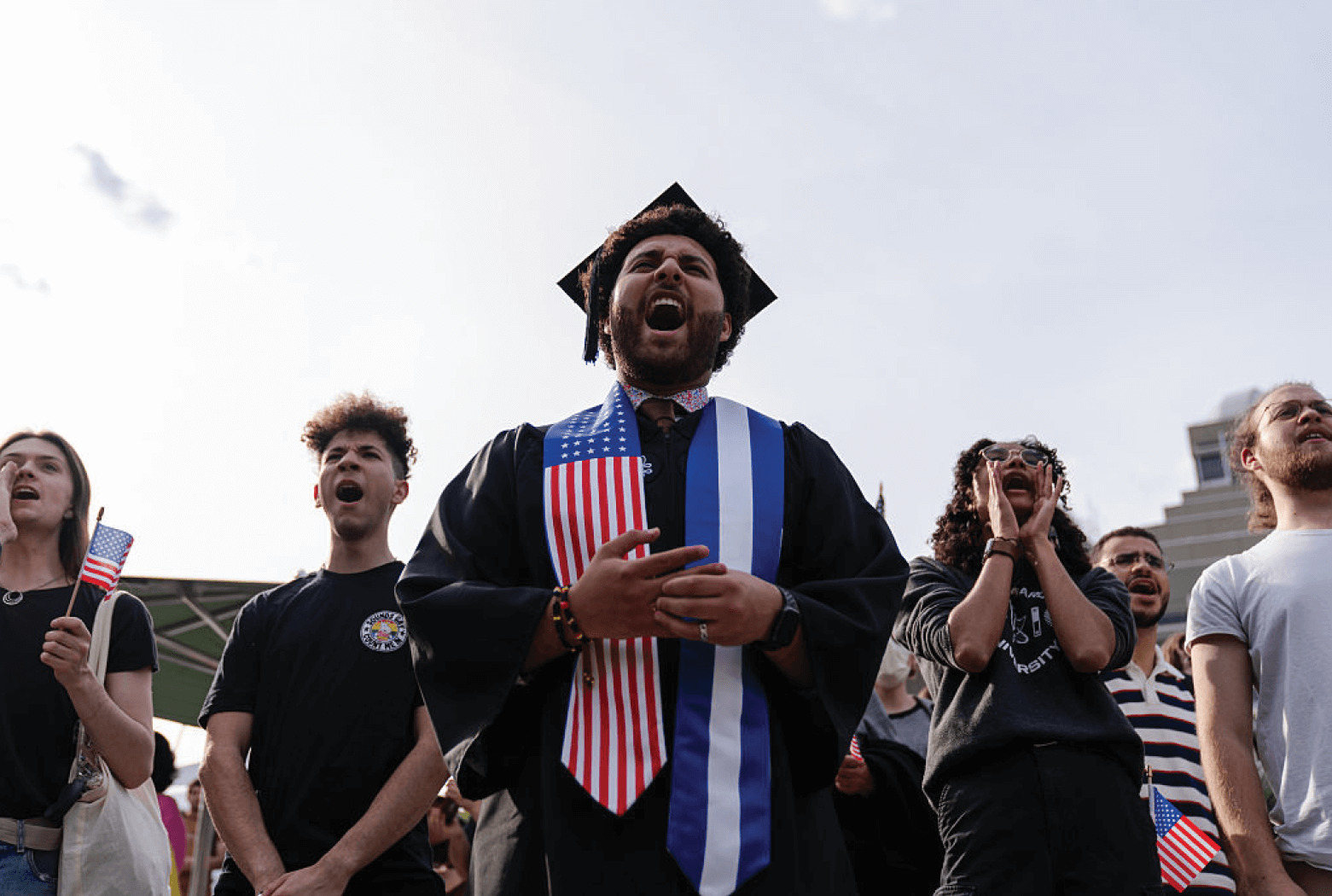
Harvard University, Cambridge, MA, 2025 (Photo by Sophie Park/Bloomberg via Getty Images)
College campuses receive outsized attention in debates about free expression—and rightly so. The knowledge developed by universities and the citizens they produce can become the status quo of tomorrow and propel social, economic, and technological progress. It should come as no surprise that would-be autocratic leaders frequently target colleges and universities in their initial efforts to consolidate power. From Erdoğan’s Turkey to Orban’s Hungary to Chavez and Maduro’s Venezuela, attempts to undermine institutions of higher education are a critical indicator of democratic backsliding.1 In the wake of the McCarthy Era, when many university professors were placed under suspicion or driven from their positions, the U.S. Supreme Court sought to correct this overreach by affirming that “[t]he essentiality of freedom in the community of American universities is almost self-evident. No one should underestimate the vital role in a democracy that is played by those who guide and train our youth.”2
The U.S. Supreme Court has long recognized academic freedom as “a special concern of the First Amendment,”3 applicable across most public and private institutions.4 But often overlooked are the existing parameters that enable universities to facilitate academic inquiry and manage campus expression. Universities, not political or partisan actors, are best positioned to make decisions that further their mission for the public good. The current landscape is ripe for state level action to protect universities’ independence and promote student and faculty freedom of expression, both of which are under attack.
State constitutions grant autonomy to their university systems in a variety of ways, most commonly through the establishment of a Board of Regents or similar entity. The “governance and control” of Montana’s public universities, for instance, grants “full power” and “authority” to a board of regents to manage the Montana university system.”5 Governors often appoint the members of the board, adding an additional political consideration, but many appointments are staggered to prevent a complete overhaul and ensure continuity. From Michigan to Hawaii to South Dakota, states have adopted statutory measures that outline the governing structure of the public university system, leveraging the power of state lawmakers to establish and protect their public universities’ status as independent institutions.
State lawmakers have a number of ways they can tailor legislation to bolster the autonomy of their state’s public universities and protect student and faculty free expression in service of their academic mission.
Case studies
Mississippi
Past legislative efforts to address campus censorship have largely arisen in response to allegations that universities tend to favor liberal or progressive viewpoints over others. These concerns have driven a wave of college censorship bills, with 70 bills introduced and 23 becoming law during the 2025 state legislative session.6 As the Mississippi case demonstrates, academic freedom can too easily be undermined absent clear protections. Mississippi now bans discussion of “divisive topics,” which is left vague, amplifying its chilling effect, as well as any requirements to participate in trainings defined broadly as “any formal or informal education, seminars, workshops, or institutional programs that focus on increasing awareness or understanding of issues related to race, sex, color, ethnicity, gender identity, sexual orientation, religion or national origin.”7 Wholesale exclusion of these topics from campus life by those with legislative and executive authority in the state, rather than allowing the scholars, students, and administrators in the institutions themselves to make the determination, is an over-reach that could be weaponized far more broadly. Such restrictions also hobble instructional and research endeavors that engage these subjects.
North Carolina
In the wake of a tumultuous year on college campuses in 2016-2017, a number of state legislatures passed bills to facilitate or protect free speech at public universities. While some efforts largely mirrored existing protections under the First Amendment, North Carolina adopted House Bill 5278 to further require institutions to include training on free expression as part of freshmen orientation, clarify the limited parameters under which institutions could restrict speech to preserve their academic mission, and more. The bill also recognized the partisan dimensions of some free speech conflicts, directing a newly created Committee on Free Expression to report annually on “substantial difficulties, controversies, or successes in maintaining a posture of administrative and institutional neutrality with regard to political or social issues.” HB 527 passed both chambers with a veto-proof majority and became law in August 2017.9

Republican presidential candidate Vivek Ramaswamy at the University of Texas, Austin, TX, 2023 (Photo by Brandon Bell/Getty Images)
Iterations of the idea
Institutions of higher education operate within a robust framework of federal and state laws, with administrative entities and the courts providing clarity when disputes arise. Within these parameters, universities are best positioned to guide their own operations, which allows them to promote innovation, train leaders and workers, and prepare the next generation for their roles in society. State lawmakers can play a role in protecting this professional domain, beating back partisan interference based on two key values:
Guaranteeing the affirmative freedom of universities to further the public good and fulfill their mission without political interference. More than 20 state constitutions provide a degree of autonomy to their public university systems, clarified further in statute or by the courts. For instance, Michigan clarified its constitution in 1963 to grant autonomy and establish governing boards for the state’s public universities. Since then, courts have rejected a wide range of legislative attempts to interfere in university decision-making, including dictating course offerings and state control over presidential searches.10 At least five additional states without these constitutional guarantees have adopted explicit statutory protections through “Autonomy Acts,” including as recently as 2025. New legislation aiming to protect university autonomy could include:
- Affirmation of the four essential freedoms of higher education outlined by Justice Felix Frankfurter in Sweezy v. New Hampshire, who wrote that “it is the business of an institution of higher education to provide an atmosphere which is most conducive to speculation, experiment and creation.” Those freedoms include the power to decide:
- Who may teach,
- What may be taught,
- How shall it be taught, and
- Who may be admitted to study.11
- Revisions to applicable statutes that clarify the boundaries between state regulatory oversight and partisan meddling.
- For instance, recent legislation introduced by Florida Representative Yvonne Hayes Hinson would task the State Board of Education with ensuring that “Florida College System institutions are… free from undue political influence and interference in academic affairs, including curriculum design, faculty appointments, research activities, and administrative operations.”12
Proponents should also consider how these protections might apply to both public and private universities and how they will be enforced if violated.
Protecting freedom of expression on college campuses, in service of a culture of intellectual inquiry. North Carolina’s HB 527 provides a potential blueprint, directing North Carolina public universities to:
- Ensure students and faculty can speak freely, within “narrowly tailored viewpoint‑ and content‑neutral restrictions on time, place, and manner of expression.” Any university-imposed limitations must provide alternative means for community members to make their voices heard.
- Guarantee students and faculty may “assemble and engage in spontaneous expressive activity as long as such activity is lawful and does not materially and substantially disrupt the functioning of the constituent institution.”
- Adopt clear policies that are publicly available and serve significant institutional interests.13
By ensuring that these protections are applied consistently across the political
and ideological spectrum, institutions of higher education can remain places
where students learn to think critically, challenge assumptions, and engage with diverse perspectives.
Institutions of higher education also have a role here, and state legislatures should expect university leaders to develop clear policies rooted in the academic mission and consistent with applicable law; apply those policies consistently across viewpoints and areas of study; and incorporate ongoing education around free expression and open inquiry for students, instructors, and staff.
Why act?
- Academic freedom and responsibility are national strengths and economic and national security assets. American universities are global leaders and essential drivers of innovation, producing scholarship that moves the nation forward and technologies that save and improve lives around the world. When universities are free from undue political interference, students and scholars can explore new ideas, challenge conventional wisdom, and drive progress.
- Universities should serve the public, not partisan agendas. Political meddling in curriculum, hiring, admission, or research further undermines public trust in a period of democratic backsliding. By safeguarding institutional autonomy state leaders ensure universities pursue knowledge, not politics.
- Free expression prepares students for a pluralistic society. A high quality college education cultivates students’ ability to engage constructively across differences in their future roles in the workplace, in their communities, and in democracy. Protecting free expression for students and faculty ensures that the next generation develops the tools to lead.
- Freedom and inclusion go hand in hand. Universities can foster inclusive communities while maintaining robust expression, inviting engagement across diverse people and views. Laws and policies that reaffirm both principles strengthen higher education’s mission to drive excellence in research, teaching, and learning.
As universities face a barrage of threats from the federal government to condition funding on political alignment, it is more urgent than ever for state lawmakers to counteract the chilling effect on what can be said or studied on their campuses. And as faith in these critical institutions of our future erodes, state leaders should encourage university leaders to foster environments of true open inquiry.
End Notes
- Cites. Daniel Levy, “Hugo Chavez Transforms Venezuelan Higher Education,” Inside Higher Ed, 9/13/2010; Benjamin Novak, “Hungary Transfers 11 Universities to Foundations Led by Orban Allies,” NY Times, 4/27/21; Ayça Alemdaroğlu, “The University in the Making of Authoritarian Turkey,” 34:2022
- While not basing its ultimate decision on the First Amendment, the Court recognized important First Amendment protected interests in academic freedom.
- Regents of Univ. of Cal. V. Bakke, 438 U.S. 265, 312 (1978).
- The First Amendment restricts government interference into protected expression. Public universities are government institutions, meaning the First Amendment limits their actions against private individuals and groups. In contrast, the First Amendment shields private universities against government overreach.
- Mont. Const. (Art. X,; §9).
- Benitez, Lauren et al., “With a Wave of New Bills in 2025, State Legislators Cast a Web of Control over Higher Education”, PEN America, 22 July 2025, https://pen.org/
- MS HB1193, 2025
- NC HB527, 2017
- Cite: Art. 26 – Campus Free Speech, G.S. § 116-300.
- Matters of statewide policy that affect public universities, such as workers compensation and labor rights, have been upheld.
- With appropriate caveat re: evolving law around affirmative action in admissions.
- FL HB609, 2025
- NC HB527, 2017