- Housing
Abundant Housing Options Near Opportunity
By Alex Brennan, Executive Director of Futurewise
Felicity Maxwell, Executive Director of Texans for Housing

The idea
Across the United States, from big cities to growing suburbs to college, beach, and mountain towns, families and workers are struggling to find and keep homes they can afford in the places they’d like to live. What was once a phenomenon of a few pricey coastal cities has metastasized to many communities across the country. If a place has good jobs or high quality of life, its housing prices are inevitably way too high. Instead of the American Dream, we have a nightmare of Americans stuck where they can’t get ahead.
Today, in the places with the most opportunity, there are not enough homes to rent or buy that meet people’s needs and budgets. That creates cutthroat competition and drives up prices, pricing out most people—including those that communities most rely on, like teachers, childcare workers, and service and retail workers.
Median housing costs have exceeded the U.S. Housing and Urban Development’s affordability threshold of 30 percent of median income by wide margins since June 2021.
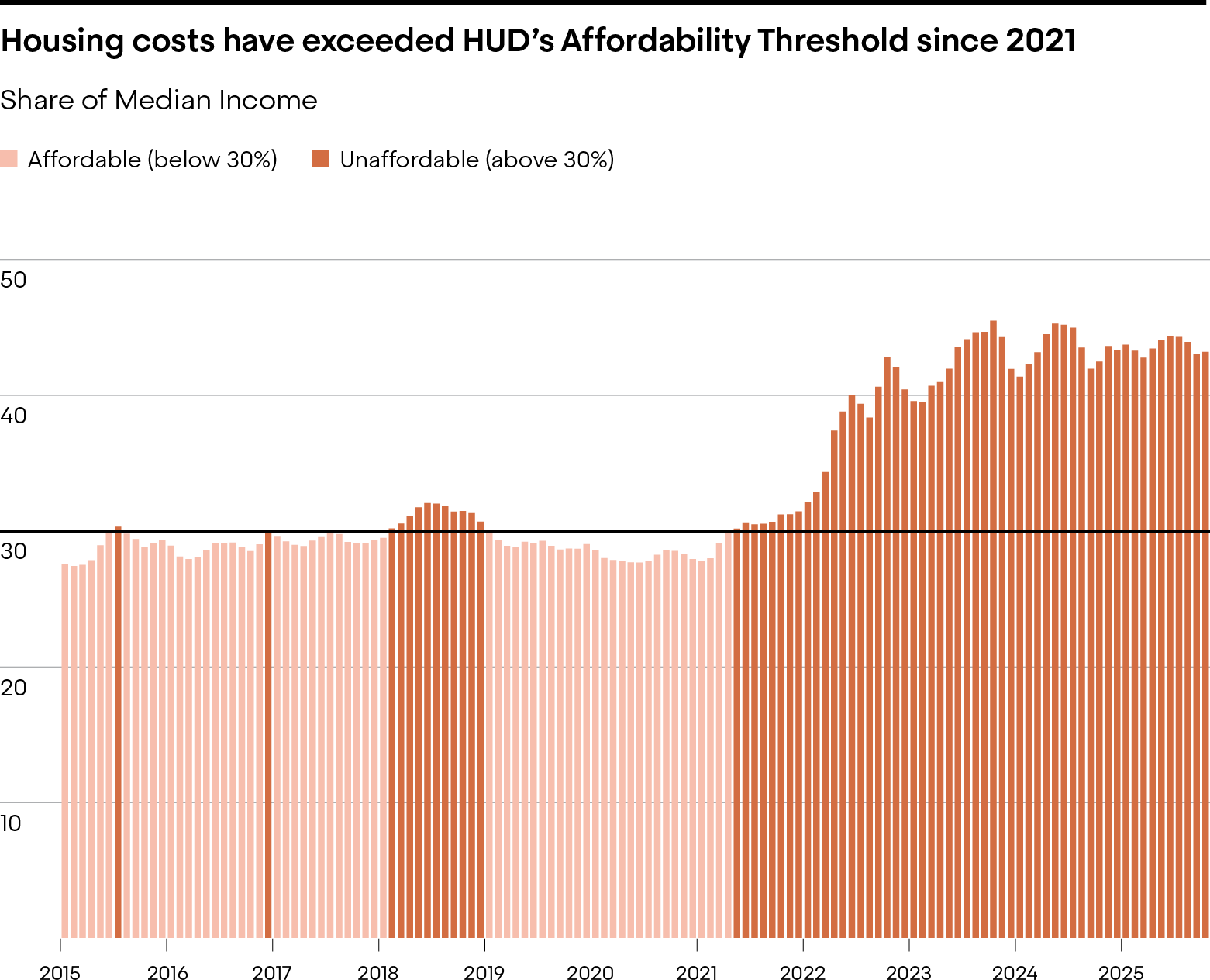
Home Ownership Affordability Monitor, The Federal Reserve Bank of Atlanta, November 2025.
Robustly expanding housing options in high opportunity areas means creating new homes of all shapes and sizes near transit and job centers in cities, suburbs, and towns across the U.S. To do this, state legislatures can create statewide standards that ensure these homes can be built, and spell out the details of regulatory best practices that expand supply, instead of constraining it—guaranteeing that covered cities allow apartment buildings in these areas to be at least six stories and provide broad flexibility on the size, shape, and number of homes included, as well as in how much space is provided for parking onsite. By providing clear, uniform guidance throughout the state that enables builders to build, lawmakers would address what in many areas is a genuine housing crisis, and spur economic growth where housing shortages now limit it.
Policies like these can open up an increased abundance of apartment homes, which in turn brings down rents across the board—a success story seen in city after city in recent years. It’s not just theory. Encouragingly, a profusion of new apartments have consistently been shown to bring down rents most on older, more naturally affordable apartments, which tend to serve lower income people.
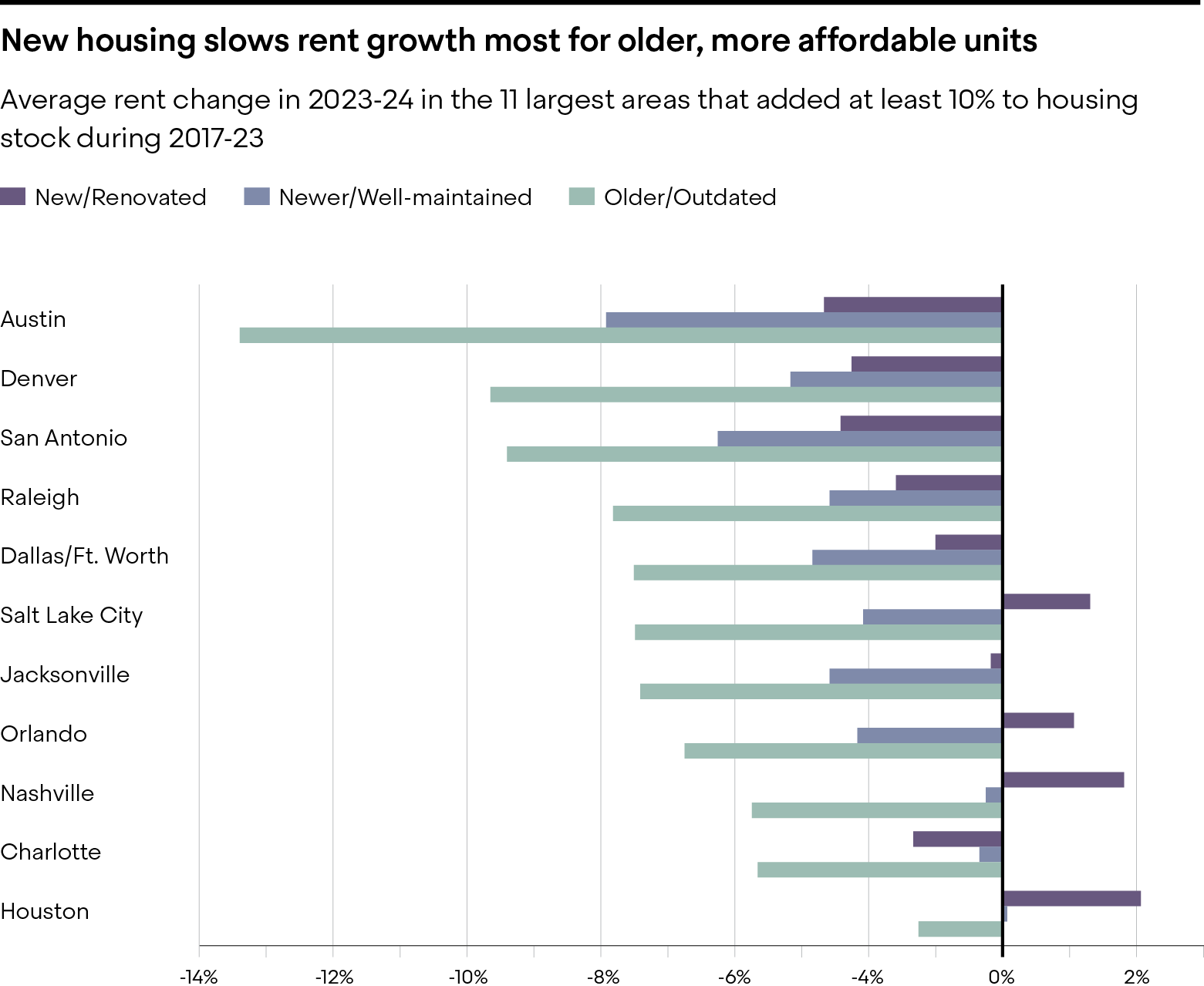
Adapted from “New Housing Slows Rent Growth Most for Older, More Affordable Units,” The Pew Charitable Trusts, July 31, 2015.
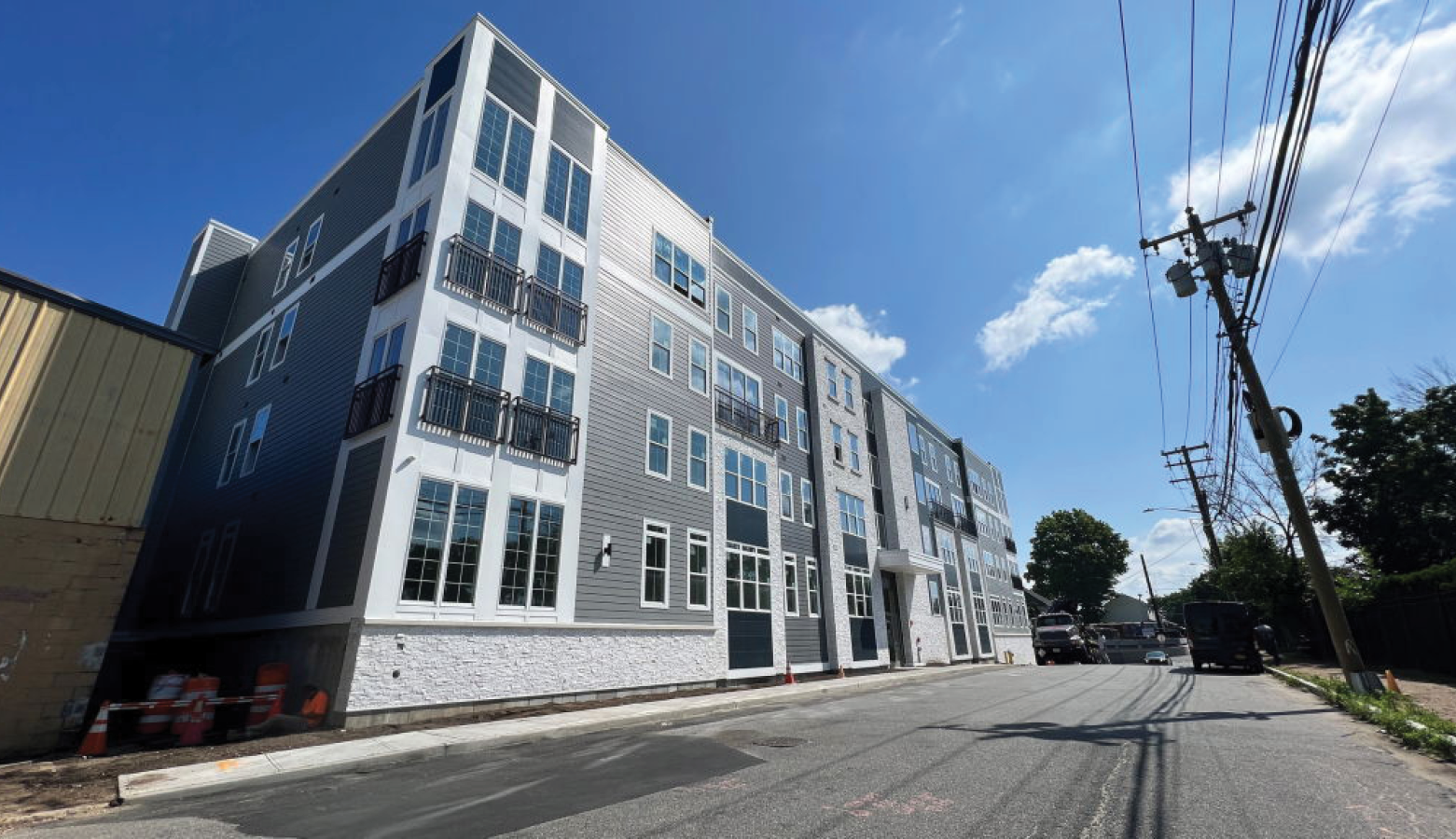
Westbury, NY, 2023. (Photo by Howard Schnapp/Newsday RM via Getty Images)
As executive directors of pro-housing organizations leading coalitions in two very different states (ruby red Texas and deep blue Washington), we led broad coalitions of strange bedfellows to adopt these policies. As members of the Welcoming Neighbors Network, which brings together local pro-housing organizations across the country to share, learn, and strategize, we have supported one another’s victories and seen resonances for what makes good policy and a successful campaign across very different states, gaining support from policymakers and popularity among the people they serve. We have shown that abundant housing near opportunity can win and make a big impact anywhere in America.
- States allowing more homes in midrise apartments near transit include Washington state (HB 1491, 2025), California (SB 79, 2025), Colorado (HB24-1313, 2024), and Massachusetts (H.5250, 2021). The earliest transit-oriented housing laws at the state level have only recently been implemented in city zoning codes, so permits are only now taking effect. However, cities with similar transit-oriented housing policies have seen hundreds of thousands of homes created.
- States that have specifically allowed more homes in midrise apartments in commercial corridors include: Texas (SB 840, 2025), New Hampshire (HB 631, 2025), Rhode Island (SB 1090, 2025), Montana (SB 243, 2025, and SB 245, 2023), Arizona (HB 2297, 2024), and Florida (SB 102, 2023). While most of these laws are early in the implementation phase, since Florida’s law took effect in 2023, the state has more than 40,000 homes planned or under construction in commercial areas.
Case studies
Washington
Landmark transit-oriented housing expansion
In 2025, Washington state adopted a remarkably bold, progressive policy expanding housing options near transit (HB 1491), which set a state-level standard for cities and larger suburbs, allowing midrise apartments on all lots within walking distance of stations for passenger rail and bus rapid transit. In one fell swoop, Washington added capacity for two million homes1 in the places people most wanted to live. Through intentional policy design, the law ensures that local regulations enable the apartments to be economically feasible to build, while producing homes that are affordable for middle class and lower-income people alike. Development in these station areas is incentivized in four ways:
- Providing infrastructure investment in the transit service as well as utility and pedestrian improvements for the growing neighborhood.
- Allowing builders to create more homes on their land.
- Completely eliminating costly parking mandates.
- Reducing impact fees and providing a 20-year property tax exemption for new housing. In exchange, a portion of the homes must be made affordable and set aside for lower-income households.
These transit-oriented communities provide other public benefits, including reducing greenhouse gas emissions and placing a lighter impact on local transportation and other infrastructure needs, saving local governments money in the long run.
Led by the state pro-housing and smart growth organization Futurewise (a member of Welcoming Neighbors Network), HB 1491 was backed by a powerhouse coalition that included unions like SEIU and the AFL-CIO, environmental advocates like the Sierra Club, the 350 Washington Network, and the Sightline Institute, affordable housing providers like Habitat for Humanity, the Housing Development Consortium, and the Washington Low Income Housing Alliance, and transit advocates like Transportation Choices Coalition.
Texas
Massively boosting housing near job center
In 2025, Texas broke new ground for abundant housing policy, authorizing SB 840, the most sweeping expansion of where apartments can legally be built in generations. SB 840 requires the 19 largest cities in Texas to allow midrise apartments by-right on all land currently zoned for commercial uses, with future additional cities subject to these new rules once they meet the bill’s population threshold of 150,000 city residents in a county of over 300,000 people. The law is conservatively estimated to enable the creation of 1.6 million homes in the Austin, Dallas, Fort Worth, and San Antonio markets alone.
Led by Texans for Housing (also a member of Welcoming Neighbors Network) on the left and Texans for Reasonable Solutions on the right, the Lone Star State coalition spanned right-wing mainstays like Texas Public Policy Foundation, Texas Young Republicans, and Texas Association of Business, to left-of-center stalwarts Texas Appleseed, Environment Texas, and UnidosUS.
Iterations of the idea
In political contexts that are supportive of transit, focus on including all parcels within walking distance of transit stops.
- The best version of this is within ½ mile of transit stops, but could be as little as ¼ mile and still be useful.
- The best legislation will include transit stops of all kinds, but should be prioritized in this order: commuter rail and light rail stops ➝ bus rapid transit stops ➝ bus and streetcar stops with frequent (at least every 15 minute) service ➝ all bus and streetcar stops regardless of frequency.
In political contexts that are more negative toward transit, focus on all commercially zoned parcels.
- The best version of this will name the various types of currently allowed uses in zones that must allow new housing, including zoning classification that allows office, commercial, retail, warehouse, parking, or mixed-use use.
- Less effective but still viable versions of this policy will only note that the zoning classification covered is commercial uses, which may create more loopholes for covered jurisdictions that want to avoid complying with the spirit of the law.
Both pieces of legislation—near transit and in commercial zoning—are compatible with one another and should not be considered mutually exclusive. If there is political viability to pass both policies, do so.
Any version of either policy will be more impactful the more specific it is about building aspects that must be allowed, including:
- Height: Ideally, the policy should be indexed to the tallest residential buildings allowed in the jurisdiction or a standard midrise apartment height, whichever is higher. To ensure the greatest number of homes near opportunity, height limits of 65 feet or higher are recommended. It is helpful to know state building codes when setting minimum heights. In the U.S., woodframe construction is cheaper than concrete and steel construction. Woodframe construction is only allowed up to a certain height (usually topping out somewhere between 60-90 feet). It usually isn’t helpful to set a minimum height that is above this building code threshold.
- Homes per acre: Ideally, the policy should provide full flexibility on the number of homes per acre. It should be indexed at least to the highest homes per acre in the municipality, or 36 homes per acre, whichever is higher.
- Parking: The policy should ideally provide full flexibility in how much parking is provided on-site (i.e., no prescriptive formula imposed at the state or municipal level) but should never allow a mandate of more than one space per home.
- Lot coverage & setbacks: The policy should ideally provide full flexibility in lot coverage and setbacks, but in lieu of that, should either index to the most permissive in the municipality or to a simple baseline standard that will enable a critical mass of homes (such as setbacks five feet from the lot line, and lot coverage of at least 70 percent).
If policymakers need to compromise, they should prioritize by reducing the number of localities to which the policy applies, by exempting municipalities below a given population threshold. Because housing markets are regional, it is best to apply a threshold that factors in both the city size and the county size (“cities above XX,XXX population in counties above YY,YYY population”).
The best and strongest versions of this legislation will require cities and towns to undergo a rezoning by a certain date, with provisions for enforcement of the law (usually default policies that take effect in noncompliant jurisdictions or clear litigation processes that third parties can use to compel compliance), and will provide strong guidelines to guide municipal ordinances in a way that results in new housing being built. For legislation that allows more homes near transit, the strongest versions will include state technical assistance and support.
Alternatively, states with administrative oversight of a particular housing sector could create new policy guidelines that supersede local land use rules. This might be particularly effective for affordable housing projects or apartments near transit.
While state laws will have the greatest impact, municipalities can and should adopt these reforms irrespective of state law (as every state, whether Home Rule or Dillon’s Rule, allows municipal zoning authorities to do so).
Why act?
- Housing is unaffordable today because there are not enough homes to rent or buy that meet people’s needs and budgets, and that creates a seller’s or landlord’s market that drives up prices for buyers or renters. Allowing more homes of all types in high opportunity areas can give buyers and renters more options, creating the leverage they need to negotiate and bring prices down.
- Reducing everyone’s commute and neighborhood congestion: Building more homes near jobs and transit will help reduce commute times for the people who live in them, and that reduces congestion for everyone else getting around the city. That increases everyone’s time with family and friends, and increases local businesses’ ability to find and retain workers.
- Restoring main streets: For many people, the walkable downtown with local businesses is an idea that resonates as an ideal community. Small shops or offices, restaurants and retail, with housing above is something our zoning codes now tend to prevent, but many cities and towns have historic areas where people flock on the weekends. Relegalizing this type of development is a powerful idea and image that is already present in people’s minds and experiences.
- People who work here ought to be able to live here: Essential workers—teachers, child care workers, fire fighters, EMTs, as well as workers who are part of the fabric of our daily life like retail, food service, delivery drivers, and the folks who fix our air conditioning—should be able to live in the communities where they work.
A picture paints a thousand words.
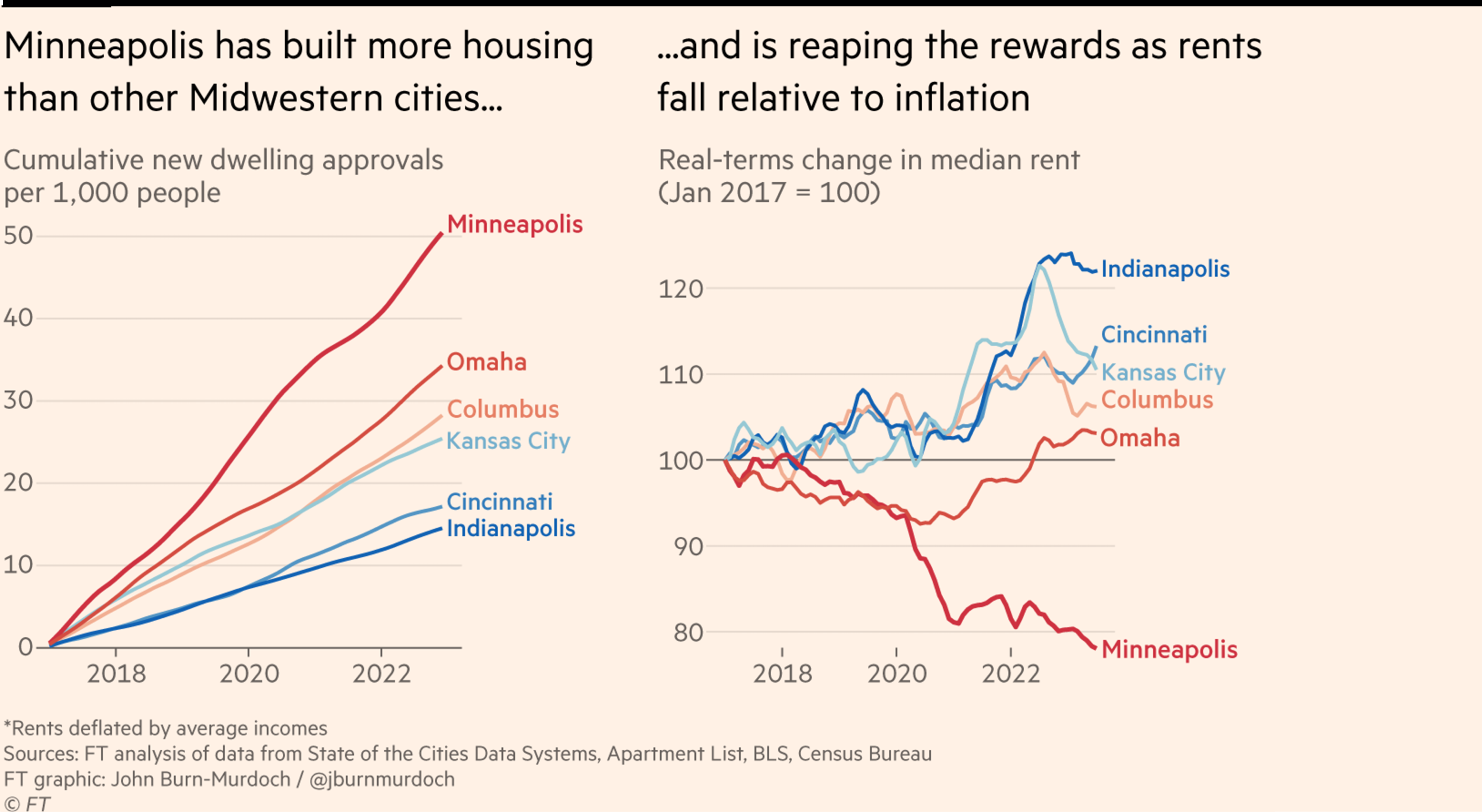
“Repeat after me: building any new homes reduces housing costs for all,” FT.com, September 15, 2023.
For specific audiences and use cases, prebuttal of the criticisms they may make can de-escalate opposition.
- How will this idea address displacement and gentrification? While displacement is almost always worse when new apartments are banned, including explicit anti-displacement companion provisions can be a powerful way to doubly address this concern. Such provisions can include protections for and investments in affordable housing and community anchor institutions, as well as tenant protections such as just cause eviction. While the interactions are complex, research shows that building more homes is essential (if not always sufficient on its own) for preventing displacement. Combining policies to allow more homes with additional anti-displacement policies and investments is the strongest approach to creating stability for vulnerable communities.
- How will this idea gather input and feedback from communities? Public input processes for housing are woefully broken and need to be redesigned to include the voices of the people most in need of housing or small businesses that are most in need of workers and customers. The design of status quo public processes (which are usually poorly advertised, inconvenient to attend, and intimidating for average people) radically oversamples the narrowest voices, those of the biggest property owners for instance, and rarely hears from people who need new homes, all of which creates a culture of inaction for city governments on housing. When inaction is taken off the table, public engagement processes are reconsidered to meet people where they are (e.g., tables at grocery stores and other high foot traffic areas).
- Why not only allow subsidized or regulated price affordable housing near transit or jobs? A growing number of Americans—middle class and working class families—make too much money to reasonably qualify for subsidized or regulated price housing but cannot afford the market rate. Allowing abundant apartment homes near jobs and amenities enables those middle income Americans to negotiate fair prices with a landlord or homebuyer, while the same policies directly benefit subsidized affordable housing for people with the very lowest incomes in our community by removing expensive and uncertain zoning barriers that are particularly deadly to nonprofit housing development.
End Notes
- Martin, Tiernan, and Alex Brennan. “Unlocking Smart Growth: The Effects of a Proposed Transit-Oriented Development Law on the Puget Sound Region.” 2024, tiernanmartin.github.io/2024-transit-oriented-development-bill/