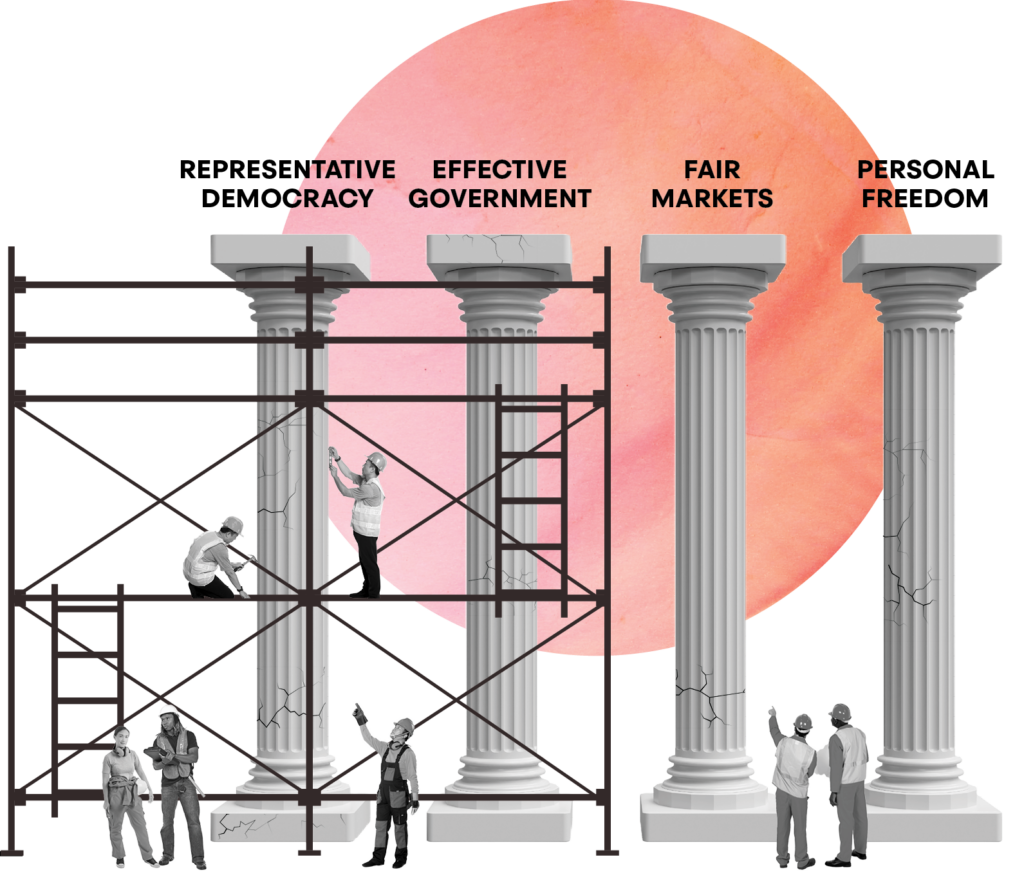
- Service
The Service Year
By Paul Monteiro, Former Secretary of Service and Civic Innovation, Maryland

The idea
Service has been a defining American characteristic that has long provided a path of opportunity.
For more than 30 years, AmeriCorps has formally engaged more than 1.4 million American young adults in public service. As the former National Director of AmeriCorps VISTA, I know firsthand the heroic work the roughly 200,000 Americans who serve in AmeriCorps each year do and the great demand to join its ranks. For every available AmeriCorps opportunity, there were, on average, an estimated 3 to 5 applicants for each year of the 2010s.1
Service programs can connect us in ways that go beyond human interaction and hands-on experience. It’s a two-way street, giving meaning and purpose to the public servant, and delivering on the promise of effective government for the person they help.
Military and other uniformed services in the United States have long been a pathway to the middle class—teaching job skills, providing a strong credential—and, in the case of the G.I. Bill after World War II, democratizing access to higher education. Conversely, Americans have traditionally come together around supporting troops, veterans, first responders, and other uniformed services whose sacrifice they value, and to whom many understand the debt of gratitude they owe.
Those who serve are more likely to engage, and engage more deeply, in the fabric of civic life.
Maryland Governor Wes Moore, a Democrat, and Utah Governor Spencer Cox, a Republican, captured the bipartisan appeal of service on September 4, 2025, at the National Press Club.2 The common theme: “service will save us” and “depolarize our society.”
Governor Moore: “I remember our second day of military training was when I learned that line, ‘leave no one behind.’ And that then became a larger governing philosophy on service and the importance of service. One of the first bills that I introduced, that I testified personally on behalf of, and that I signed was a bill called the Serve Act, which made Maryland the first state in the country that now has a service year option for all of our high school graduates. Every high school graduate now has a chance to have a year of paid service to the state of Maryland. If you want to serve veterans, if you want to serve young people, if you want to serve older adults, if you want to work on the environment, it is your choice. And let’s give you an opportunity to do it with someone from a different community, from a different part of the state. Especially in this time of political divisiveness and political vitriol, I just believe deeply that service will save us. If we can be a state, if we can be a nation, where people are actually working together on hard things, getting to know each other, getting to be able to create those common bonds, that is the thing that helps to break apart this calcified division that is just sitting over people.”
Governor Cox: “I so appreciate Governor Moore’s leadership on service, and we literally did steal their idea. That’s what governors do. That’s how it works. That’s why we’re laboratories of democracy. The research shows very clearly that service is a way to depolarize our society. It’s intuitive, but the research actually backs it up. It’s also good for your health. We now have a lot of psychiatrists who, before they will prescribe medication, are prescribing actual service. It lowers your blood pressure. It helps with your mental health. There are so many good things that come from giving back, and that makes a difference.”
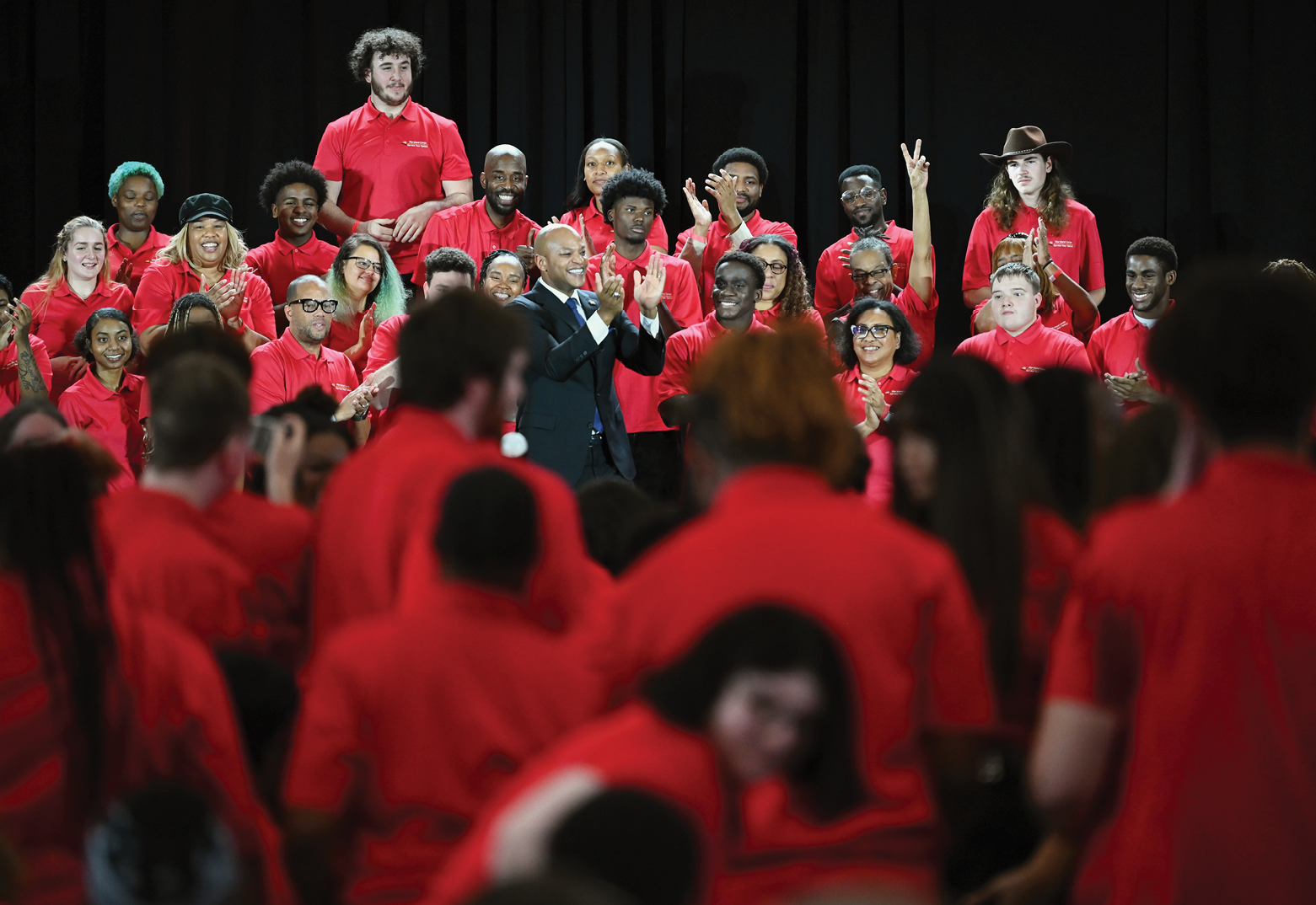
Service Year Option and Maryland Corps Launch, 2023. (Photo by MDGovpics)
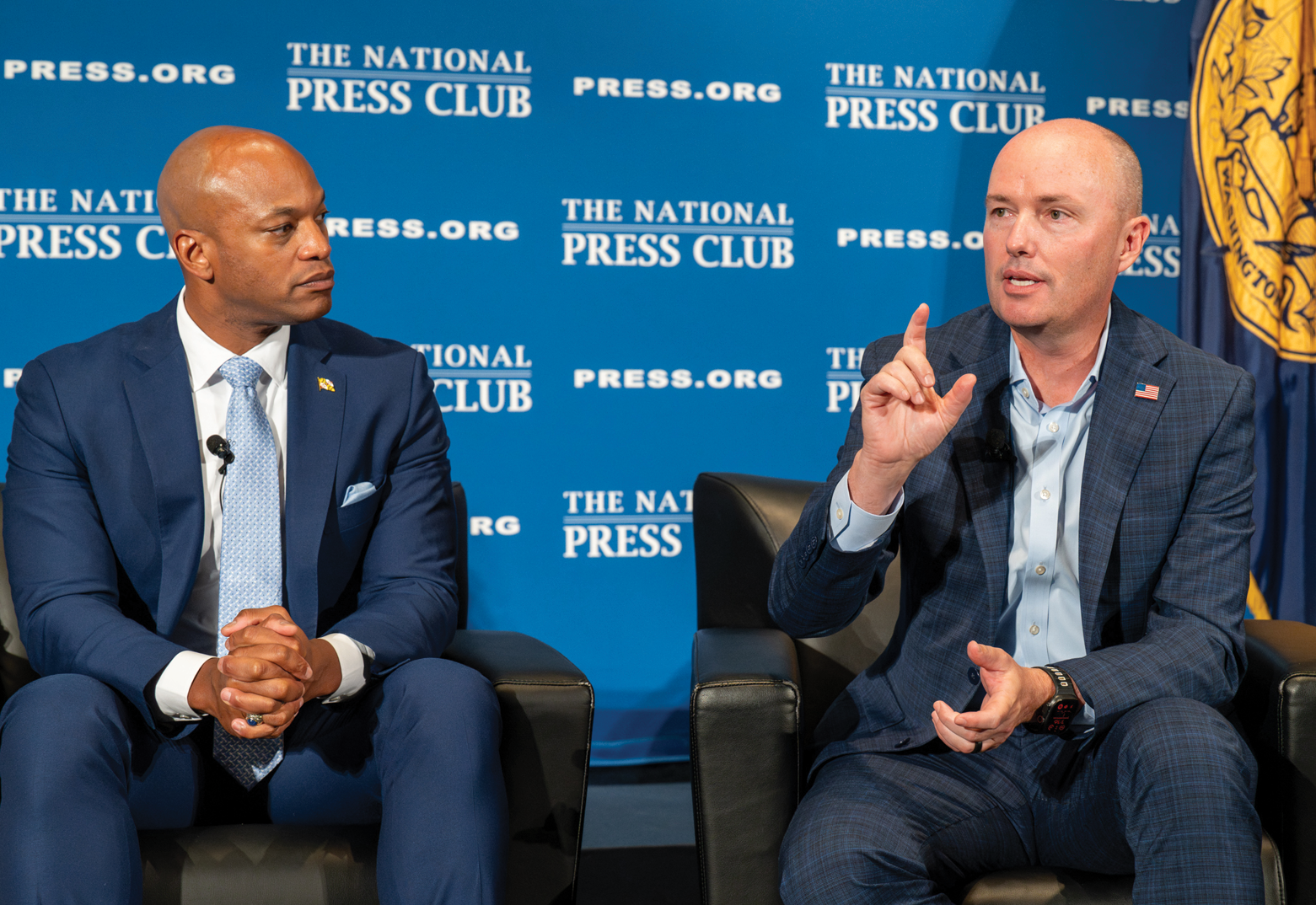
Governor Wes Moore and Governor Spencer Cox at the National Press Club, 2025. (Photo by MDGovpics)
As the first Secretary of Service and Civic Innovation in the nation, I helped launch the Maryland Corps and Service Year Option, now in its third year.
Maryland’s service year program affords young adults a paid year of service through a local organization that deepens connections with their communities while building a personal foundation for their future success. It reinforces crumbling worker pipelines for service in state agencies and civil society roles that support state functions. As both Governor Moore and Governor Cox said, we believe the program can even narrow our partisan divides.
Case studies
Maryland
“On day one of my administration, I ordered the creation of the Department of Service and Civic Innovation,” Governor Moore declared in his 2023 inaugural address.3 “This was not a stunt. This was not because it sounded nice. This was because it is a fundamental part of who I am, and it’s in the DNA of this state.”
I was proud to work with Governor Moore to create the nation’s first state-level service year option, and the first cabinet-level Department of Service and Civic Innovation (DSCI), to ensure the efficient administration of Maryland’s service programs.
Three core ideas have guided Maryland’s service program:
- Broad eligibility: Barriers to participation, like requiring a college path or an arbitrary age limit, signal that service is an exclusive privilege, rather than a common American inheritance. Moreover, they frequently exclude populations that could most benefit from service options. A 27-year old setting on a possible career path for the first time has just as much to gain, and give, as a 22-year-old.
Local and nonpartisan: Local communities know their needs best, and since every state includes blue, purple, and red communities, state programs must be nonpartisan. - Oriented to professional development: Service requires some altruism and some measure of willingness to serve in any capacity, but young adults cannot afford to delay professional development, and our workforce is strengthened by this additional path to skills. Beyond the government and nonprofit sectors, we have found for-profit employers some of our most valuable program partners. Maryland always planned to be the “first mover” in subsidizing eligible nonprofit and for-profit employers to enable their participation in the inaugural year before dialing back the state investment in for-profit companies over time. Opportunities at private companies provide members with job skills that put them on long-term career pathways that they likely otherwise would not have access to. For example, Early Charm Ventures in Baltimore trained members with skills related to the custom manufacturing of advanced materials including 3D printed plastic, metal, ceramic and biologic parts, and flame-retardant textile inks.
Governor Moore originally created DSCI through an executive order, which got it off to a day one start, but the budget bill allowed lawmakers of both parties a say in departmental and program design later in the process. The General Assembly offered input, held hearings, and voted to approve the Serving Every Region Through Vocation Exploration (SERVE) Act,4 which created the Young Adult Service Option (open to ages 18-21) and funded the formerly dormant Maryland Corps (open to all ages).
That latter part means about 10% of our latest service class is over age 24. These older members enrich the experience for the whole cohort. They are a leavening agent in each class, bringing different life experiences and intergenerational learning.
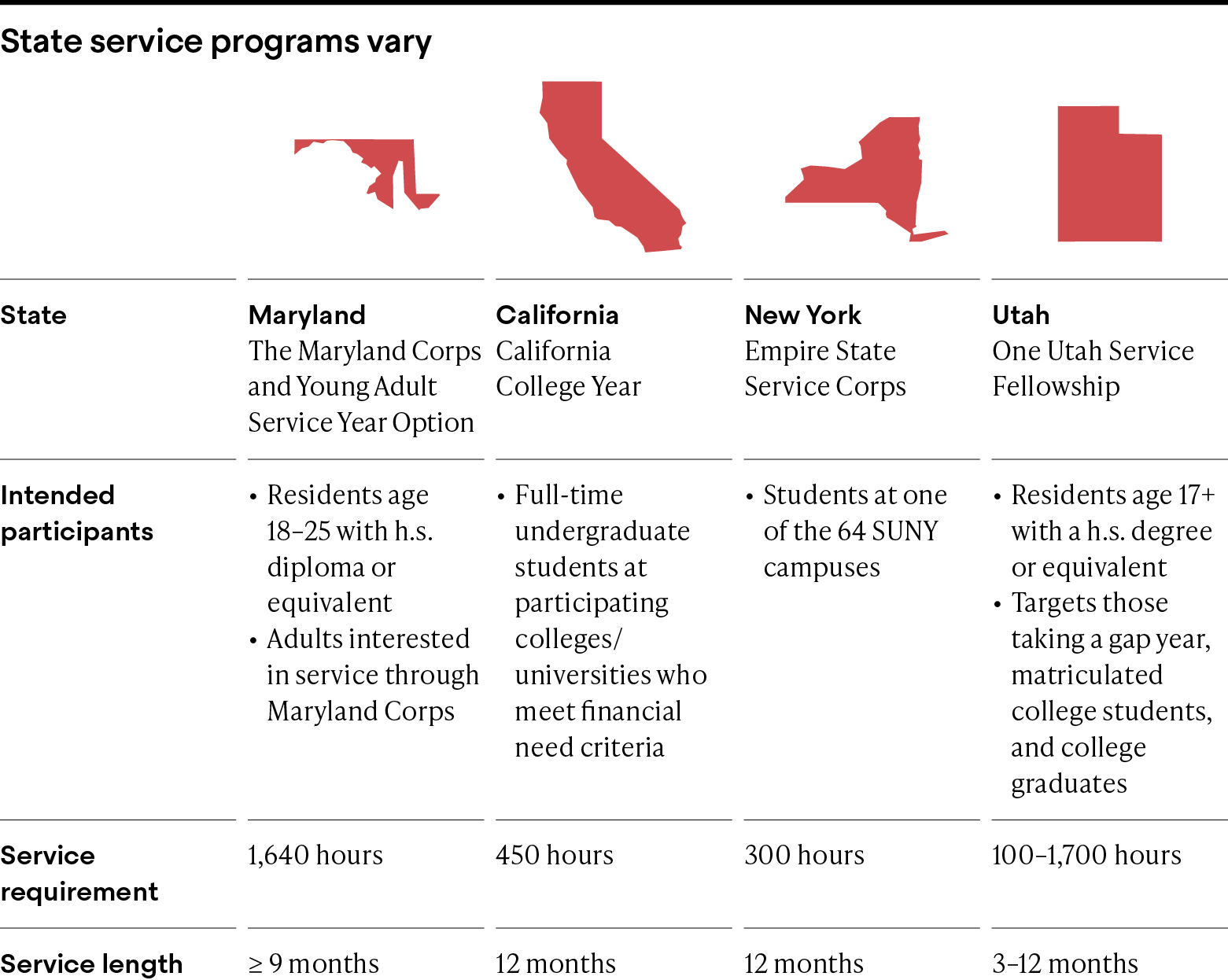
The SERVE Act mandated participation and growth numbers: 200 members in the first year class growing to 2,000 members in the fourth year. These growth targets were lowered in FY25 due to state budget cuts, but the programs continue to expand.5 Members must work 40 hours per week and be paid $15 per hour or the applicable county minimum wage, whichever is higher.6 Upon completing the nine month service requirement, they earn a completion award of $6,000. Unlike other service programs, DSCI doesn’t mandate members spend the award on college costs.
Members receive valuable mentoring and professional development, including financial and civic literacy workshops. Our civic literacy includes real-world practicalities, like how to speak in front of the City Council. We also recruit for-profit businesses to be host sites, along with nonprofits, state agencies, and local governments. Host sites directly oversee members and set their service tasks, while providing fringe benefits and contributing to professional development.
Maryland’s Department of Human Services hosted members focused on assisting our neighbors in accessing public benefits. During tax season, members were also trained to prepare tax returns at no cost for our neighbors needing assistance preparing their tax filings and accessing refunds. Partnering with the Chesapeake Bay Trust, members are placed into roles focused in environmental restoration, environmental education, sustainable agriculture, energy conservation, and forestry.
In the first two years, over 700 Marylanders completed the program. In September, we launched our largest class yet, with 850 members7 and more than 200 host sites.8 Additionally, in partnership with other state agencies, we pioneered two new service tracks: the Benefits Navigator Corps, to deliver hands-on support to help residents access essential programs like SNAP and Medicaid and file taxes, and the IT Accessibility Corps, receiving firsthand experience in document remediation, website testing, and digital accessibility certification.
Though we have host sites in every Maryland jurisdiction, we still have a way to go in building our class size capacity—but we have no shortage of enthusiasm from young Marylanders. We had four applicants for every spot a host organization provided.
As federal actions shift costs to states already navigating uncertain economic environments, cost-sharing is crucial for the long-term sustainability of service programs. In Maryland, host sites contribute to members’ wages through a tiered cost-sharing model.
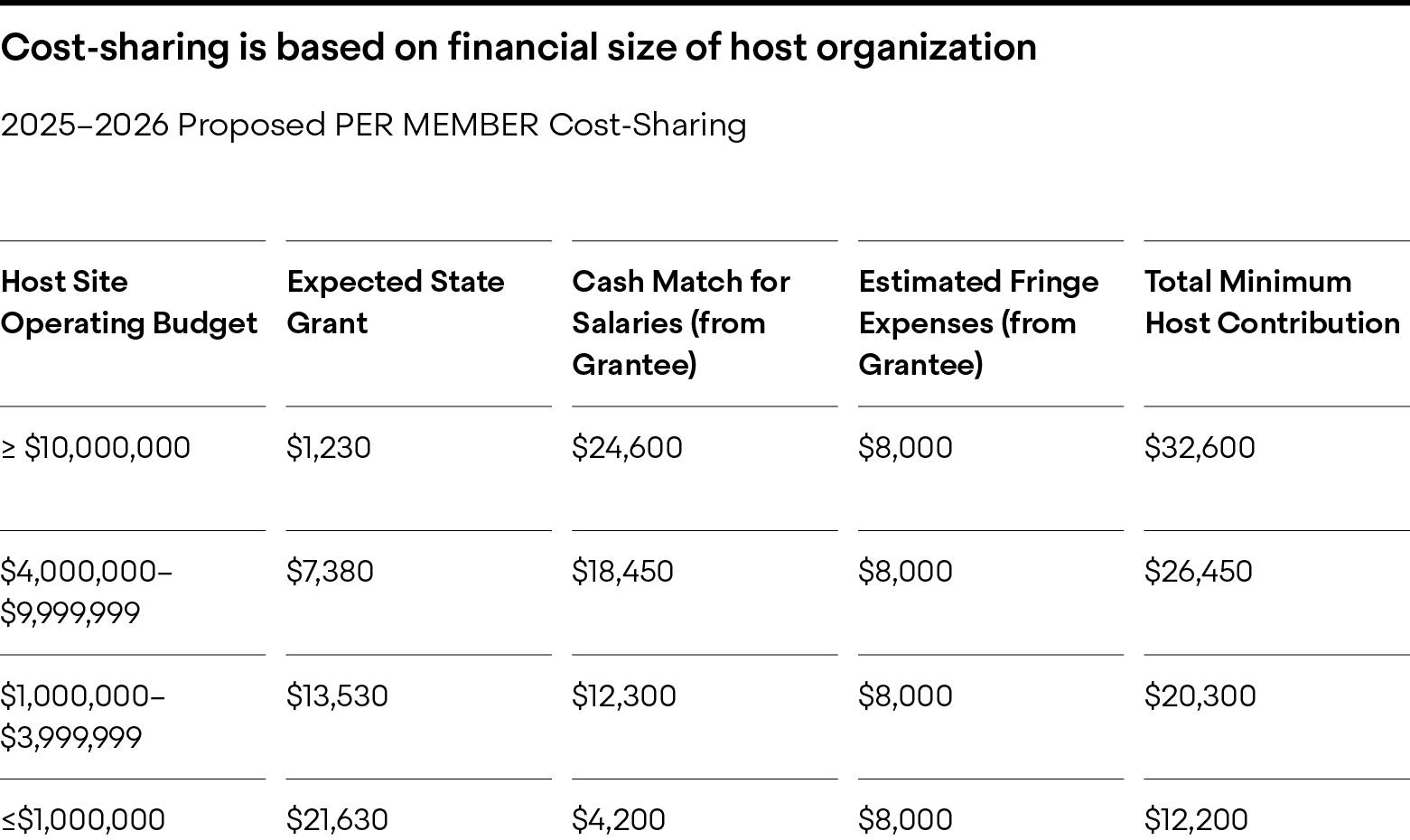
Maryland Department of Service and Civic Innovation, Budget Analysis, February 11, 2025.
Maryland’s model assesses cost-share payments based on an organization’s operating budget, striking a balance between enabling smaller organizations with fewer resources to participate and ensuring that host sites—which benefit from a member’s work—contribute to the program’s fiscal viability. As the service corps expands, the DSCI plans to increase cost-sharing9 to further improve sustainability.
Utah
In 2024, Utah created the One Utah Service Fellowship. Maryland and Utah’s models share some components, including cost-share mechanisms and host-site partnerships. However, Utah prioritizes flexibility over Maryland’s focus on deep engagement. Utah’s program includes two pathways, one for matriculated college students and one for gap year students and recent graduates. Within each pathway, fellows can choose among three term lengths, enabling them to scale their commitment to best fit their schedules.10 Additionally, the Fellowship requires that the program’s award be spent on college expenses.
Service opportunities include roles like program coordinator, teacher support, social media manager, mental health school navigator, and service assistant at a range of nonprofits and educational institutions, from the Girl Scouts of Utah to Blue Star Families. “Service, and having people join in, is the new normal,” a service-engaged student said at one of Governor Cox’s service events. “It’s like what the cool people do now.”
Iterations of the idea
In recent years, California and New York have also taken innovative steps to expand service options.
In California, Governor Gavin Newsom recently bolstered the College Corps, a service program where fellows complete 450 service hours annually with a local community-based organization, earning up to $10,000 and an Education Award.11 The 2025-26 budget made the program permanent12 and included funding to expand from 45 to 55 participating colleges and universities.13
In New York, Governor Kathy Hochul launched the Empire State Service Corps in 2024. Targeted at students on participating State University of New York campuses, members undertake at least 300 service hours over an academic year for $16/hour.14 15
State leaders have been taking only a portion of the idea for these approaches, but they reveal a common insight: given the opportunity, young adults are ready to serve from coast to coast. Over 10,000 applicants competed for the 3,400 slots16 in the California College Corps in 2024-25, 1,500 for the 500 slots17 in the 2025-26 Empire State Service Corps, and more than 3,50018 for the third class of the Maryland Corps. Service programs can provide a brand new avenue of opportunities for young people already facing major hurdles in gaining employment.
The Council of State Governments. This data has been modified by The States Forum.
Expanding service opportunities benefits from close collaboration between governors and state legislative leaders. According to the Council of State Governments, in 34 states, governors possess varying authority to reorganize their state governments.19 This power provides an executive-level first step for states interested in following Maryland’s lead and establishing dedicated departments, but to fund new programs and place them on a sound fiscal footing, governors will need to work with state lawmakers who hold appropriations authority.
Why act?
- Keeping young talent in town: Particularly in rural areas, young people are likely to leave if there’s not a learning opportunity, a career opportunity, or a paid way to engage with their home community. AmeriCorps has helped close a gap, keeping or returning young talent to underserved communities seeing increasing shortages of essential services. Nationwide, 43% of AmeriCorps alumni had stayed in their communities of service—until the program was cut by President Trump.20 While Maryland’s program encourages members to choose a different part of the state, we’re seeing those who stay in their own communities form deeper engagements.
- Off your phones and into your communities: At a time when young adults are dealing with unprecedented levels of technology-driven isolation, service is a demonstrated pathway to expanding in-person social networks and exposure to individuals of different backgrounds and beliefs. Former Surgeon General Vivek Murthy described it as a virtuous cycle, where service boosts feelings of social connectedness, which—alongside many positive benefits—in turn increases the likelihood of engaging in further service.21
- It’s voluntary, but not volunteerism: Delineating between service and volunteerism is crucial to building support for service year programs. Though often treated synonymously, service members perform paid work that would otherwise be done by an employee, and enter the workforce and form connections they otherwise wouldn’t.
By clearly framing the distinction from volunteerism, arguments about whether service members should receive professional development or compensation become much easier to address. No one expects teachers, social workers, or public safety officers to work for free.This distinction unlocks more effective recruitment appeals for host sites and potential service members. A reputation for inconsistent organizational payoffs22 surrounds volunteerism. Emphasizing the differences means you can pitch the service year to host sites as a multi-month situational job interview or career-track internship where performance matters—with costs defrayed by the state.
- Succession planning: The public sector is reaching a demographic and technology tipping point. In 2024, the Bureau of Labor Statistics found that across the federal, state, and local government workforce, more workers are 55 and older than are aged 16-34.23 Developing strong pipelines to attract new people to public service is critical to effective government and strong communities. As of December 2024, 18 local jurisdictions or state agencies across Maryland reported hiring at least one graduate following their service year.24
- Skills development: As the use of artificial intelligence becomes more ubiquitous in the workplace, young people with real-world achievements stand a better chance of retaining jobs. There’s even a component of reverse mentorship, where service members who are digitally fluent can teach older workers new skills.
- Rowing together: Finally, as Governor Cox said, service is an excellent way to bridge our entrenched political divides. In 2025 survey results, the national nonprofit Service Year Alliance reports that 77 percent of alumni of AmeriCorps, Peace Corps, and other service programs said they were likely to engage in conversations with people they disagreed with, compared to 52 percent before the service. 91 percent of these alumni vote regularly, compared to 64 percent of the general population.25
In 2023, 23 of the 52 Republicans in the Maryland General Assembly voted for the SERVE Act, despite its being a signature initiative of the new Democratic governor. Central to this bipartisan appeal is that service benefits from a constellation of supporters, ranging from school and county leaders to professional and trade associations. This potential coalition could be influential in every state.
So many entities have a stake: school leaders, setting graduating students on a path to success; hospital leaders, improving healthcare staffing crises; trade associations, bettering recruitment and early workforce development; local government, reinforcing crumbling workforce pipelines; and young adults, gaining experience, skills, and connections, while serving their communities.
Beyond the individual and sectoral impacts, the most important systemic contribution may be to the battered institution of American democracy itself, with a conscious and conscientious way to engage a new generation of citizens.
End Notes
- Bridgeland, John M., and John J. DiIulio, Jr. Will America Embrace National Service? The Brookings Institution & Service Year Alliance, October 2019. https://www.brookings.edu/wp-content/uploads/2019/10/National-Service_TEXT-3.pdf
- Moore, Wes, and Spencer Cox. “Dignity and Respect, Not Division.” National Governors Association, 16 Sept. 2025, www.nga.org/news/commentary/dignity_not_division/
- Moore, Wes. “Governor Wes Moore Delivers His First State of the State Address.” Office of Governor Wes Moore, 1 Feb. 2023, governor.maryland.gov/news/press/pages/governor-wes-moore-delivers-his-first-state-of-the-state-address.aspx
- Maryland General Assembly. Fiscal and Policy Note for Senate Bill 551: Department of Legislative Services, 2023 Session. Maryland General Assembly, 2023, https://mgaleg.maryland.gov/2023RS/fnotes/bil_0001/sb0551.pdf
- Maryland. FY 2026 Maryland State Budget Highlights. Maryland Department of Budget and Management, 2025, dbm.maryland.gov/budget/Documents/operbudget/2026/proposed/FY2026MarylandStateBudgetHighlights.pdf
- Maryland General Assembly. Fiscal and Policy Note for Senate Bill 248: Department of Service and Civic Innovation – Maryland Corps Program Service Year Option Pathways – Revisions. 2025 Regular Session, Department of Legislative Services, 2025, mgaleg.maryland.gov/2025RS/fnotes/bil_0008/sb0248.pdf
- Wason, Sanya. “Maryland Corps Welcomes Nearly 600 Inductees at UMD Xfinity Center.” The Diamondback, 12 Sept. 2025, dbknews.com/2025/09/12/maryland-corps-launch-event-umd/
- Moore, Wes. “Governor Moore Launches Third Maryland Corps and Service Year Option Cohort During 9/11 Day of Service and Remembrance.” Office of Governor Wes Moore, 11 Sept. 2025, https://governor.maryland.gov/news/press/pages/Governor-Moore-Launches-Third-Maryland-Corps-and-Service-Year-Option-Cohort-During-911-Day-of-Service-and-Remembrance.aspx
- Maryland. FY 2026 Operating Budget Testimony: I00 Department of Service and Civic Innovation. Maryland Department of Budget and Management, 11–12 Feb. 2025, dbm.maryland.gov/budget/FY2026Testimony/I00.pdf
- One Utah Service Fellowship: A Blueprint for States, May 2025, https://cdn.prod.website-files.com/63bf22e0fab9d23d9b51322c/6835b92b9246f2b838b6212e_State%20Service%20Blueprint.pdf
- California Volunteers. “CaliforniansForAll College Corps.” California Volunteers, Office of the Governor, www.californiavolunteers.ca.gov/californiansforall-college-corps/
- Moreno Valley College. “College Corps Becomes Permanent State Program; MVC to Expand Fellow Participation.” Moreno Valley College News, 2 July 2025, mvc.edu/news/20250702-college-corps-becomes-permanent-state-program.php
- State of California. California College Corps Program: Budget Change Proposal 0680‑005‑BCP‑2025‑GB, Fiscal Year 2025‑26. California Department of Finance, 10 Jan. 2025, bcp.dof.ca.gov/2526/FY2526_ORG0680_BCP7936.pdf
- The State University of New York. “Chancellor King Celebrates Second Cohort of Empire State Service Corps Across 43 SUNY Campuses.” SUNY News, 17 Sept. 2025, www.suny.edu/suny-news/press-releases/9-25/9-17-25/essc.html
- “Empire State Service Corps: Eligibility and Application Process.” Blog of the State University of New York, 21 Nov. 2024, blog.suny.edu/empire-state-service-corps-at-suny/
- Legislative Analyst’s Office. The 2025–26 Budget: Governor’s Office of Service and Community Engagement. California Legislative Analyst’s Office, 11 Mar. 2025, www.lao.ca.gov/Publications/Report/5015
- The State University of New York. “Chancellor King Celebrates Second Cohort of Empire State Service Corps Across 43 SUNY Campuses.” SUNY News, 17 Sept. 2025, www.suny.edu/suny-news/press-releases/9-25/9-17-25/essc.html
- Moore, Wes. “Governor Moore Launches Third Maryland Corps and Service Year Option Cohort During 9/11 Day of Service and Remembrance.” Office of Governor Wes Moore, 11 Sept. 2025, https://governor.maryland.gov/news/press/pages/Governor-Moore-Launches-Third-Maryland-Corps-and-Service-Year-Option-Cohort-During-911-Day-of-Service-and-Remembrance.aspx
- The Council of State Governments. Table 4.4: The Governors: Powers. Book of the States, 2022 edition, https://bookofthestates.org/tables/2022-4-4/
- Martin, Gillen Tener. “How AmeriCorps Kept Young Talent in Rural Communities.” Washington Monthly, 7 July 2025, washingtonmonthly.com/2025/07/07/how-americorps-kept-young-talent-in-rural-communities/
- United States. Public Health Service. Office of the Surgeon General. Our Epidemic of Loneliness and Isolation: The U.S. Surgeon General’s Advisory on the Healing Effects of Social Connection and Community. U.S. Department of Health and Human Services, May 2023, http://www.hhs.gov/sites/default/files/surgeon-general-social-connection-advisory.pdf
- Kahl, Sue Carter. “Does Volunteerism Have a Low Value Proposition?” Volunteer Commons, 23 Nov. 2021, www.volunteercommons.com/2021/11/23/does-volunteerism-have-a-low-value-proposition/
- Bureau of Labor Statistics. “Table 18b. Employed Persons by Detailed Industry and Age.” Current Population Survey (CPS) Annual Averages, U.S. Bureau of Labor Statistics, https://www.bls.gov/cps/cpsaat18b.htm (Bureau of Labor Statistics)
- Maryland General Assembly, Department of Legislative Services. 2026FY – Operating Budget Analysis: I00 – Department of Service and Civic Innovation. 9 Feb. 2025, https://mgaleg.maryland.gov/pubs/budgetfiscal/2026fy-budget-docs-operating-I00-Department-of-Service-and-Civic-Innovation.pdf (mgaleg.maryland.gov)
- “New Data: Service Years Boost Alums’ Employment, Leadership, and Civic Engagement.” Service Year Alliance, 26 Aug. 2025, https://www.serviceyearalliance.org/new_data_supports_that_service_years_boost_alums_employment_leadership_and_civic_engagement (serviceyearalliance.org)