- Government Hiring
Fixing Government Hiring
By Robert Gordon, Executive Vice President for State Initiatives, Recoding America Fund

The idea
If democracy is going to deliver for its citizens, government needs the right people doing the people’s work. Strong staff matter—in the classroom1 or on the beat,2 in crafting technology,3 or paving roads.4 We have to simplify government hiring so that managers can choose great employees fast.
Too often, state and local governments get hiring wrong.5 They post turgid job descriptions in complex classifications6 that scare off strong applicants. They require archaic civil service exams that dramatically slow the hiring process without adequately winnowing the field. They select for staff on resume keywords that reward exaggeration, gaming, and insider knowledge over expertise. They take so long to hire7 that individuals with options give up and go elsewhere. And they sort job roles into rigid compensation systems8 that aren’t sensitive to the labor market, making it impossible to recruit for some positions even as others pay more than necessary.
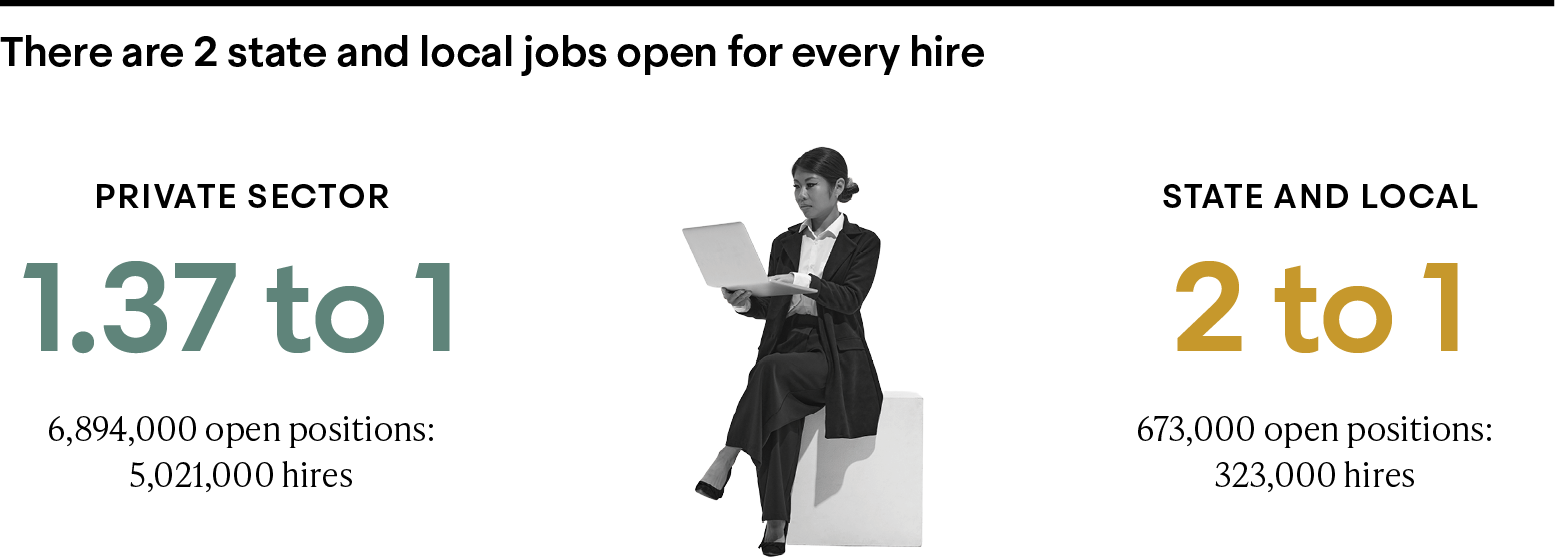
U.S. Bureau of Labor Statistics, September 2025. Photo element: Anton Vierietin (iStock)

New York, NY, 2009. (Photo by Daniel Acker/Bloomberg via Getty Images)
For too long, “HR” has been geared around compliance, a set of boxes for both managers and employees to check. In a government that works, HR is a critical strategic function, recruiting and placing people in the right jobs at the right cost to taxpayers.
Fortunately, this is not just rhetoric. States are beginning to change.
Case studies

U.S. Bureau of Labor Statistics, September 2025.
Iterations of the idea
- Eliminate outdated civil service exams and create effective skills-based assessments instead.
- Modernize job classifications and write job postings in plain, compelling English.
- Allow individuals to apply for many jobs through a single posting.
- Allow multiple agencies to hire off of a single posting.
- Keep job postings open and allow agencies to hire from them over long periods.
- Give managers more discretion to hire qualified applicants.
- Raise pay in key roles facing chronic shortages, and align the full pay scale with market demands.
- Overhaul business processes and introduce an effective Applicant Tracking System to make the hiring process more efficient.
- Create performance management systems that connect employee goals to organizational goals, define competencies critical to jobs, provide for regular feedback, fairly evaluate employee contributions, elevate and reward effective employees, and swiftly improve or remove those who do not get results.
- Include employee performance in the context of annual salary increases, updating traditional seniority or step increases.
- Enable and evaluate variation within systems, so that different agencies can apply different approaches, and leaders can learn from those changes, and the system can improve over time.
- Use AI to review and improve classification systems, employee handbooks, hiring processes, and job listings. For more on the possibilities from AI for streamlining government, see Let’s Tidy Up State Government, The States Forum Journal, Summer 2025, by my colleague, Jennifer Pahlka.
So much of excellence in employment depends on qualities that are not visible in a test or on a resume. This does not make hiring arbitrary, but it does mean that managers often need discretion to consider data from interviews or reference calls that cannot be reduced to formulas. But that discretion can and must be channeled–by holding managers accountable for their results. In an agency where people are just punching the clock, a mid-level manager might get away with hiring somebody’s nephew. But if that manager needs to deliver on clear metrics, he will think twice. For this reason, streamlined hiring benefits from streamlined firing.
Each in their own way, all of the states above point to important pathways forward.
Improving these practices may differ state to state. Virtually everywhere, HR departments have discretion under current law to improve their hiring processes and technology, cutting the time to hire in the process. The impressive startup Work for America offers two case studies of the difference that a modern Applicant Tracking System can make. State legislatures can jumpstart this work by holding hearings to focus executives on what’s broken today and offering with very modest funding for reform.
More structural changes may require legislation, but even here, there is often surprising executive discretion. Rarely do laws require thousands of job classifications or turgid job descriptions. Even pay levels can be a policy call, though it may sit with a semi-independent board or commission rather than an executive agency. Civil service exams and termination procedures are in state statutes, and in some cases, in state constitutions.
In short: Effective legislators can drive change simply by asking important questions about why hiring in government is so hard. Modest funding may be helpful to drive some changes, while others are about courage more than money. Everything depends on raising the profile of an issue that few take seriously today.
Why act?
- Hiring the best workforce is a simple imperative. State governments are multi-billion dollar enterprises, performing the life-saving and life-changing work of delivering health care, public safety, our children’s education, and economic vitality. It should not be a bureaucratic maze.
- We need to open the process. Civil service systems are based on the right principles, but too often they have become what they meant to stop, rewarding insiders and blocking those who do not know how to work the system. It’s time to simplify the process so governments can meet the needs of their constituents.
- Everyone has a stake in state governments that work. Even in an era of deep partisan divides, civil service reform can unite a broad coalition. In New York, organized labor supported the initial suspension of civil service exams. In Tennessee, Republicans in power worked with19 and gained the support of the Tennessee State Employees Association20—which cited “weeks of negotiations and help from our friends in the House and Senate.” And in North Carolina, Democrats and Republicans came together21 in the legislature to establish a mandate for change. By focusing on the problem and listening to competing views, the states were able to push through structural changes in their civil service systems and make reform more durable.
End Notes
- Chetty, Raj, John N. Friedman, and Jonah E. Rockoff. “Measuring the Impacts of Teachers II: Teacher Value-Added and Student Outcomes in Adulthood.” American Economic Review, vol. 104, no. 9, 2014, pp. 2633–2679. https://www.aeaweb.org/articles?id=10.1257/aer.104.9.2633
- Bonkiewicz, Officer Luke. “The IMPACTT of a Patrol Officer: Evaluating Productivity Metrics.” National Institute of Justice, U.S. Department of Justice, 13 July 2020, https://nij.ojp.gov/topics/articles/impactt-patrol-officer-evaluating-productivity-metrics
- Herd, Pamela, Eric R. Giannella, Jeremy Barofsky, Luke Farrell, and Donald Moynihan. “Interventions to Automate Medicaid Renewals Reduce Procedural Denials and Increase Coverage.” Health Affairs, vol. (forthcoming/2025), https://www.healthaffairs.org/doi/full/10.1377/hlthaff.2025.00316
- Liscow, Zachary D., Cailin Slattery, and William Nober. State Capacity and Infrastructure Costs. SSRN Electronic Journal, Yale Law & Economics Research Paper, Aug. 23, 2025, https://papers.ssrn.com/sol3/papers.cfm?abstract_id=4522676
- Gordon, Robert, and Gabe Paley. “New York’s Civil Service System vs. Public Sector Progress.” Vital City, 11 Nov. 2025, https://www.vitalcitynyc.org/articles/new-yorks-mamdani-ny-civil-service-system
- National Governors Association. Empowering Progress: Harnessing Skills-Based Strategies to Drive Public Sector Excellence. National Governors Association, Feb. 2025, https://www.nga.org/publications/empowering-progress-harnessing-skills-based-strategies-to-drive-public-sector-excellence/
- Institute for Responsive Government. Cutting Red Tape for States to Hire Top Talent: A Landscape Overview. ResponsiveGov.org, 26 June 2025, https://responsivegov.org/research/cutting-red-tape-for-states-to-hire-top-talent-a-landscape-overview/
- Risher, Howard. “What’s in a Name? Everything That’s Wrong With Job Classification.” Government Executive, 16 June 2015, https://www.govexec.com/management/2015/06/whats-name-every-s-wrong-job-classification/115369/
- Justin, Raga. “NY Faces Looming State Government Workforce Crisis.” Times Union, 1 Feb. 2023, https://www.timesunion.com/state/article/ny-faces-looming-state-government-workforce-crisis-17756737.php
- Public Employees Federation. NY HELPS: Frequently Asked Questions. March 2024, https://www.pef.org/wp-content/uploads/2024/03/NY-Helps-FAQ.pdf
- “Frequently Asked Questions.” City of Albany, City of Albany, https://albanyny.gov/m/faq?cat=26#question-190
- New York State Department of Civil Service. “NY HELPS.” cs.ny.gov, https://www.cs.ny.gov/help/
- New York State Department of Civil Service. NY HELPS – State Update Through September 2025. September 2025, https://www.cs.ny.gov/help/pdf/monthly-appointments/september_2025.pdf
- News Staff. “Tennessee Governor Bill Haslam Signs TEAM Act into Law.” Clarksville Online, 25 Apr. 2012, https://www.clarksvilleonline.com/2012/04/25/tennessee-governor-bill-haslam-signs-team-act-into-law/
- Risher, Howard. “One State’s Proven Strategy for Civil Service Reform.” Government Executive, 7 May 2019, https://www.govexec.com/management/2019/05/one-states-proven-strategy-civil-service-reform/156773/
- Barrett, Katherine, and Richard Greene. “How Tennessee Transformed the Way It Hires and Fires People.” Governing, 28 Oct. 2015, https://www.governing.com/archive/gov-tennessee-civil-service-reform.html
- Henkel, Clayton. “With Double‑Digit Vacancy Rates, NC State Government Looks to Revamp Its Hiring Process.” NC Newsline, 17 Mar. 2025, https://ncnewsline.com/2025/03/17/with-double-digit-vacancy-rates-nc-state-government-looks-to-revamp-its-hiring-process/
- North Carolina Office of State Human Resources. “Session Law 2025‑34: State Hiring Accessibility and Modernization.” oshr.nc.gov, https://oshr.nc.gov/session-law-2025-34-state-hiring-accessibility-and-modernization
- Tennessee State Employees Association. “TEAM Act Timeline.” TSEA Online, 13 years ago, https://tseaonline.org/issues/team-act/team-act-timeline/
- Tennessee State Employees Association. “TEAM Act.” TSEA Online, published ~13 years ago, https://tseaonline.org/issues/team-act/
- Henkel, Clayton. “With Double‑Digit Vacancy Rates, NC State Government Looks to Revamp Its Hiring Process.” NC Newsline, 17 Mar. 2025, https://ncnewsline.com/2025/03/17/with-double-digit-vacancy-rates-nc-state-government-looks-to-revamp-its-hiring-process/